![A detailed schematic diagram illustrating the flow of electrons and protons through the electron transport chain within the inner mitochondrial membrane. The top of the diagram is labeled 'intermembrane space' and the bottom is labeled 'mitochondrial matrix,' separated by a membrane depicted as two rows of blue circles with yellow lines projecting between them. Four irregular shapes of different colors span the membrane are lined up from left to right and are labeled 1 through 4. A black arrow runs through the shapes, starting at 1 and turns down at 4. The first shape is pink, is labeled 1 and contains 2 electrons. An arrow points up from the shape to 4 hydrogens. Below the shape is an irregular blue rectangular labeled 'N A D H' containing two electrons with an arrow pointing to another irregular blue rectangle labeled 'N A D ⁺' with 2 hydrogens. The next shape is dark purple, is labeled 2 and contains 2 electrons. An arrow points up to a light blue square shape labeled Co-Q. Below the shape is an irregular purple rectangular labeled FADH-2 containing two electrons with an arrow pointing to another irregular purple rectangle labeled FAD with 2 hydrogens. The next shape is green, is labeled 3, and has an arrow pointing up to 4 hydrogens. The next shape is a blue irregular circle with no number and is labeled Cyt-c. The next shape is purple, is labeled 4 and has an arrow pointing up to 2 hydrogens. Below is an equation with illustrations for the molecules: '[2H⁺ + ½O₂ + 2e⁻ → H₂O] ×2.'](images/electron_transport_chain.jpg)
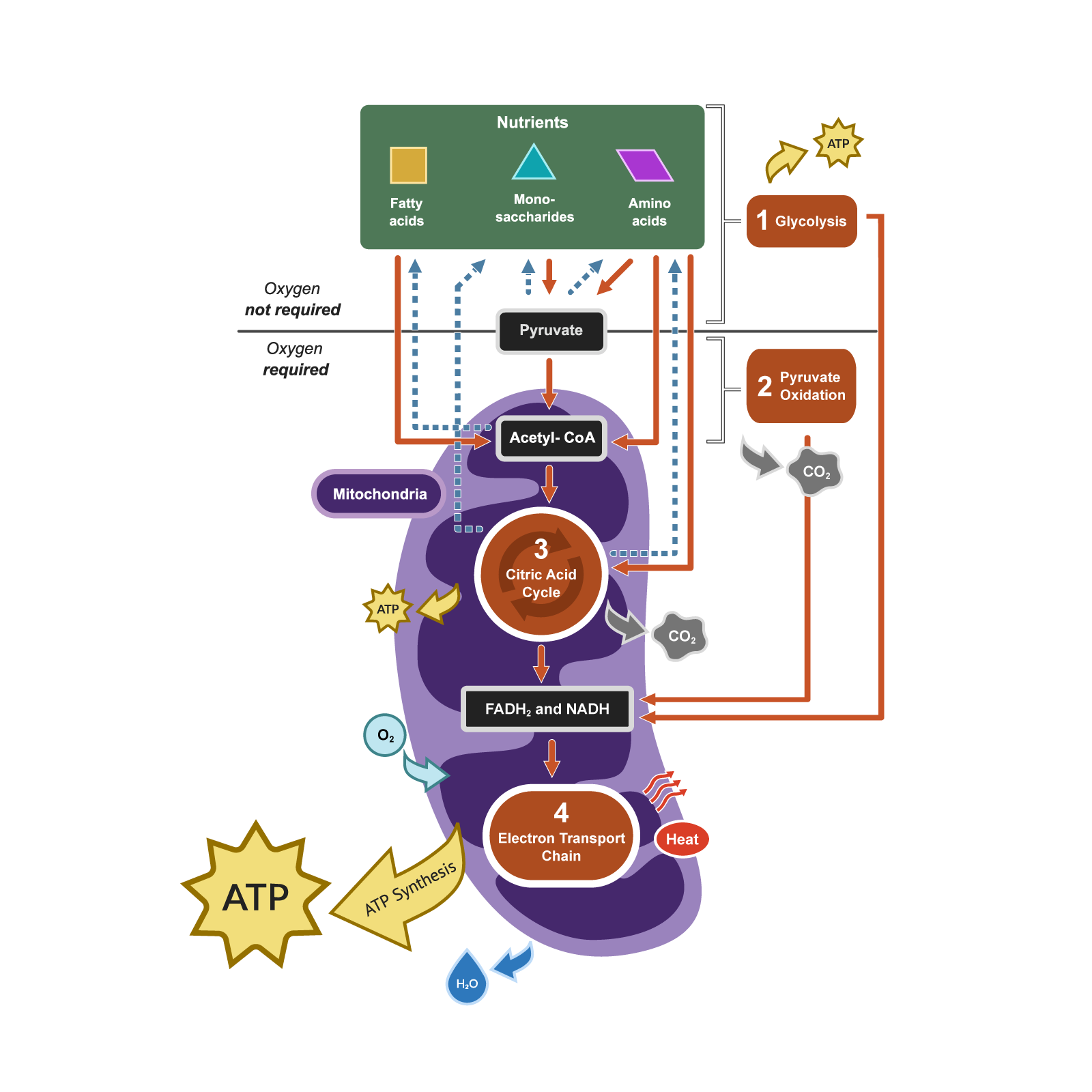
A schematic diagram depicting the process of cellular respiration in a series of steps.
At top is a rectangle labeled nutrients containing fatty acids, monosaccharides, and amino acids. A purple concave oval below nutrients is labeled Mitochondria. A dividing line under a rectangle labeled Pyruvate sits between the nutrients box and mitochondria. Above the dividing line, text: Oxygen not required. Below the line, text: Oxygen required.
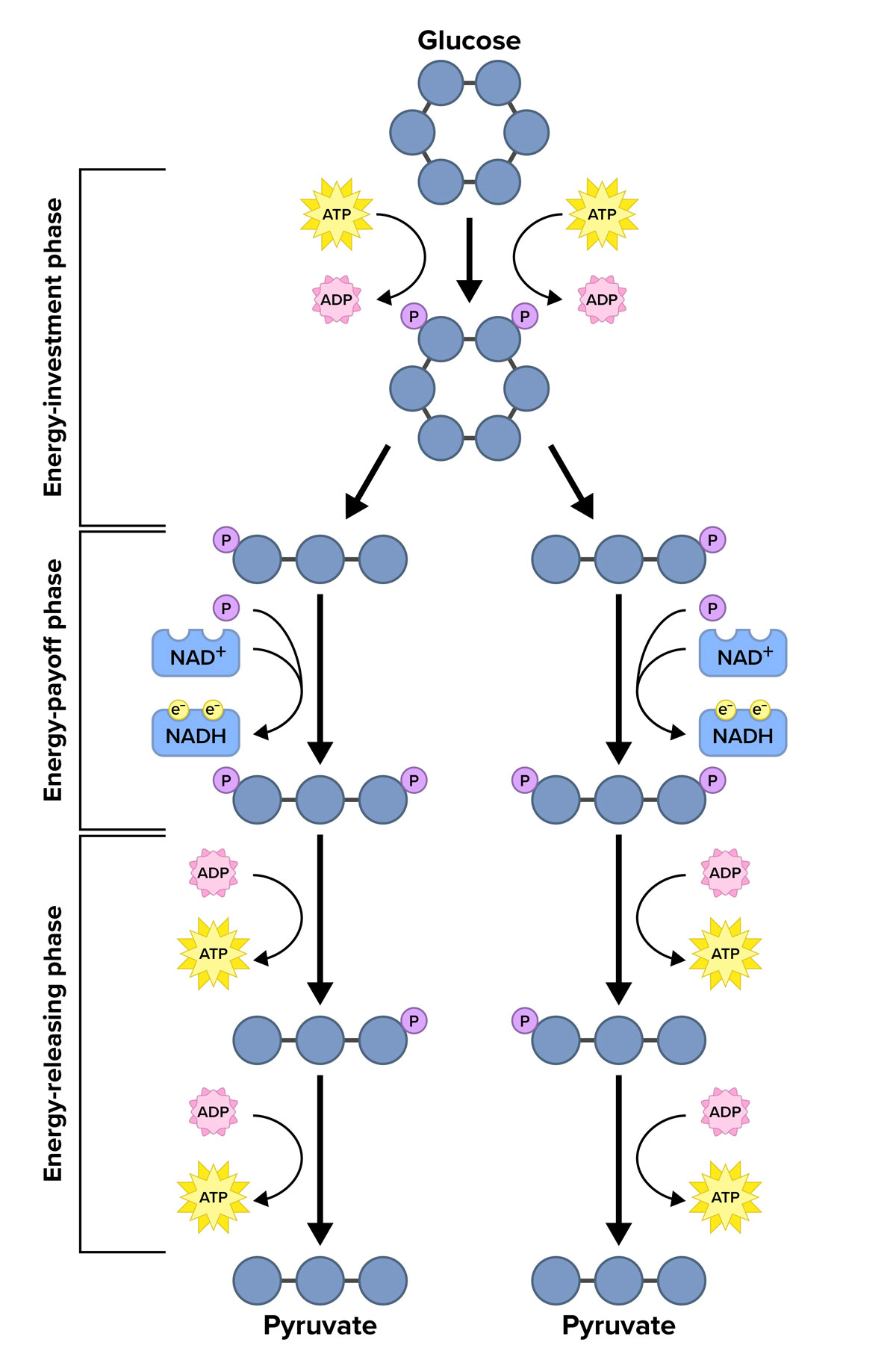
A rounded box labeled 1 Glycolysis with a bracket contains the nutrients rectangle and Pyruvate. Red solid arrows point from Monosaccharides and Amino acids to Pyruvate and blue dotted arrows point in the opposite direction. A yellow arrow points from the Glycolysis box to a yellow star labeled A-T-P.
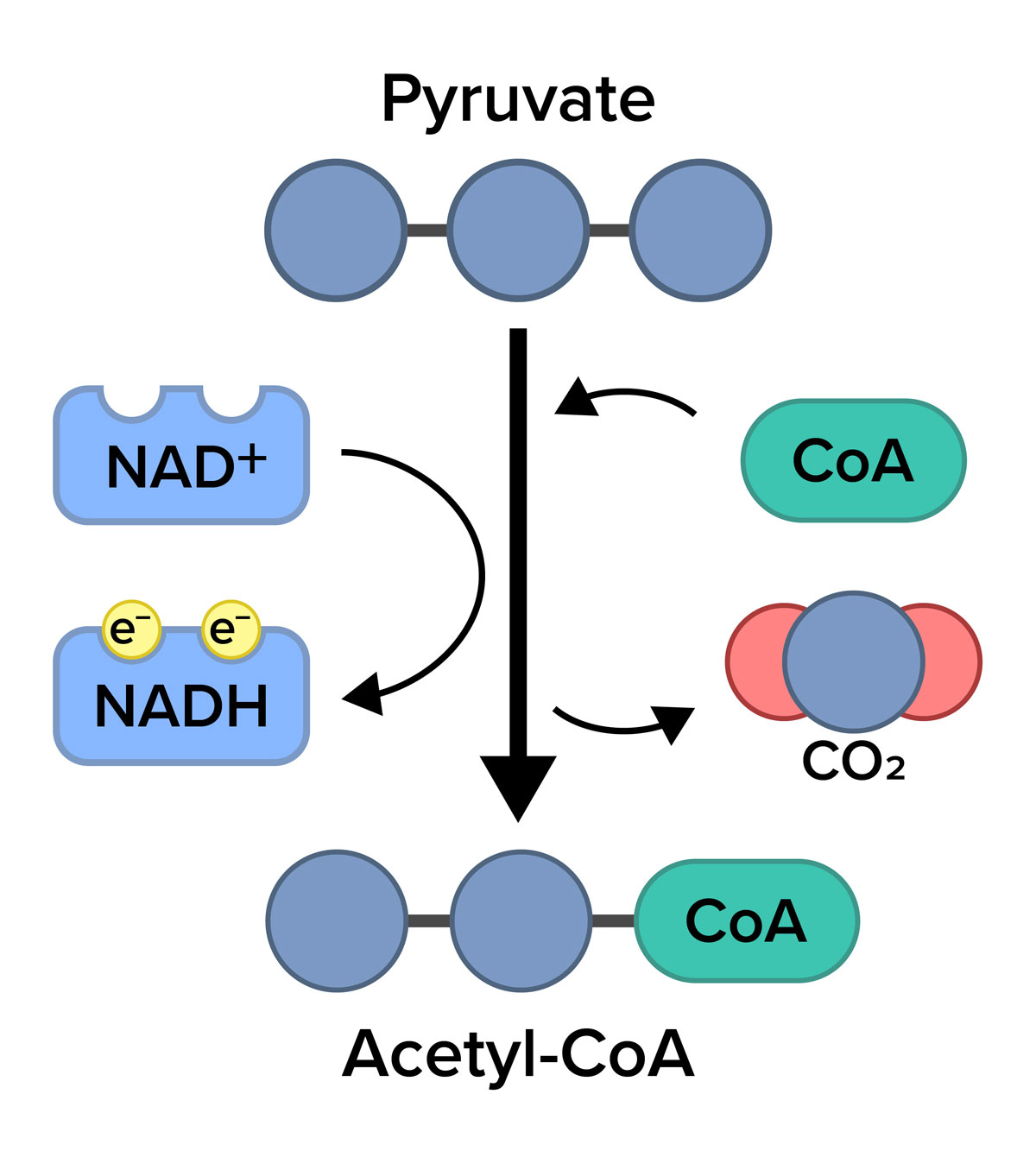
A rounded box labeled 2 Pyruvate oxidation with a bracket contains Pyruvate and a red solid arrow pointing to Acetyl-C-O-A within the top of the Mitochondria. Red solid arrows point from the fatty acids and Amino acids to Acetyl-C-O-A. A blue dotted arrow points from Acetyl-C-O-A back to fatty acids. A gray arrow points from the Pyruvate oxidation box to an irregular gray shape labeled C-O-2. Red solid arrows also lead from both the Glycolysis and Pyruvate oxidation boxes to a rectangle inside the mitochondria labeled F-A-D-H-2 and N-A-D-H.
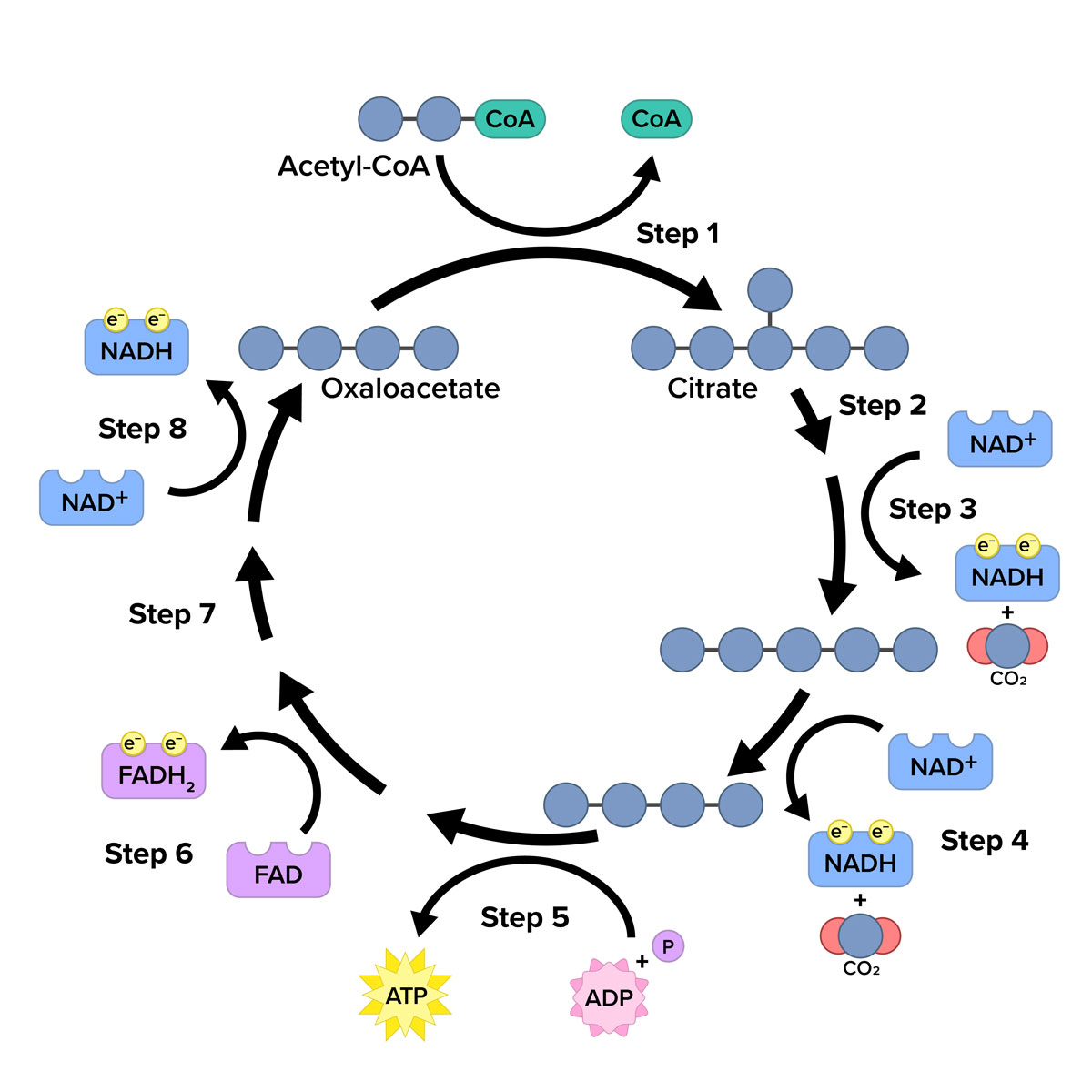
A circle labeled 3 Citric Acid Cycle sits within the Mitochondria. Acetyl-C-O-A and a red solid arrow points down to Citric Acid Cycle. A red solid arrow points from Amino acids to Citric Acid Cycle. Blue dotted arrows lead from Citric Acid Cycle back to the Amino acids and the monosaccharides. A yellow arrow to the left of Citric Acid Cycle points to a yellow starburst shape labeled A-T-P... A gray arrow to the right of Citric Acid Cycle points to an irregular gray blob labeled C-O-2. A red solid arrow below Citric Acid Cycle points to F-A-D-H-2 and N-A-D-H also within the Mitochondria.
A rectangle labeled 4 Electron Transport Chain sits within the bottom of the Mitochondria. A red solid arrow below F-A-D-H-2 and N-A-D-H points down to Electron Transport Chain. A light blue circle labeled O-2 with an arrow sits outside and points into the Mitochondria. A blue droplet labeled H-2-O with an arrow sits outside and points away from the Mitochondria. To the right of the electron transport chain are three wavy red arrows labeled Heat. A large yellow arrow labeled ATP Synthesis points from the Mitochondria to a large yellow starburst labeled A-T-P outside the Mitochondria.
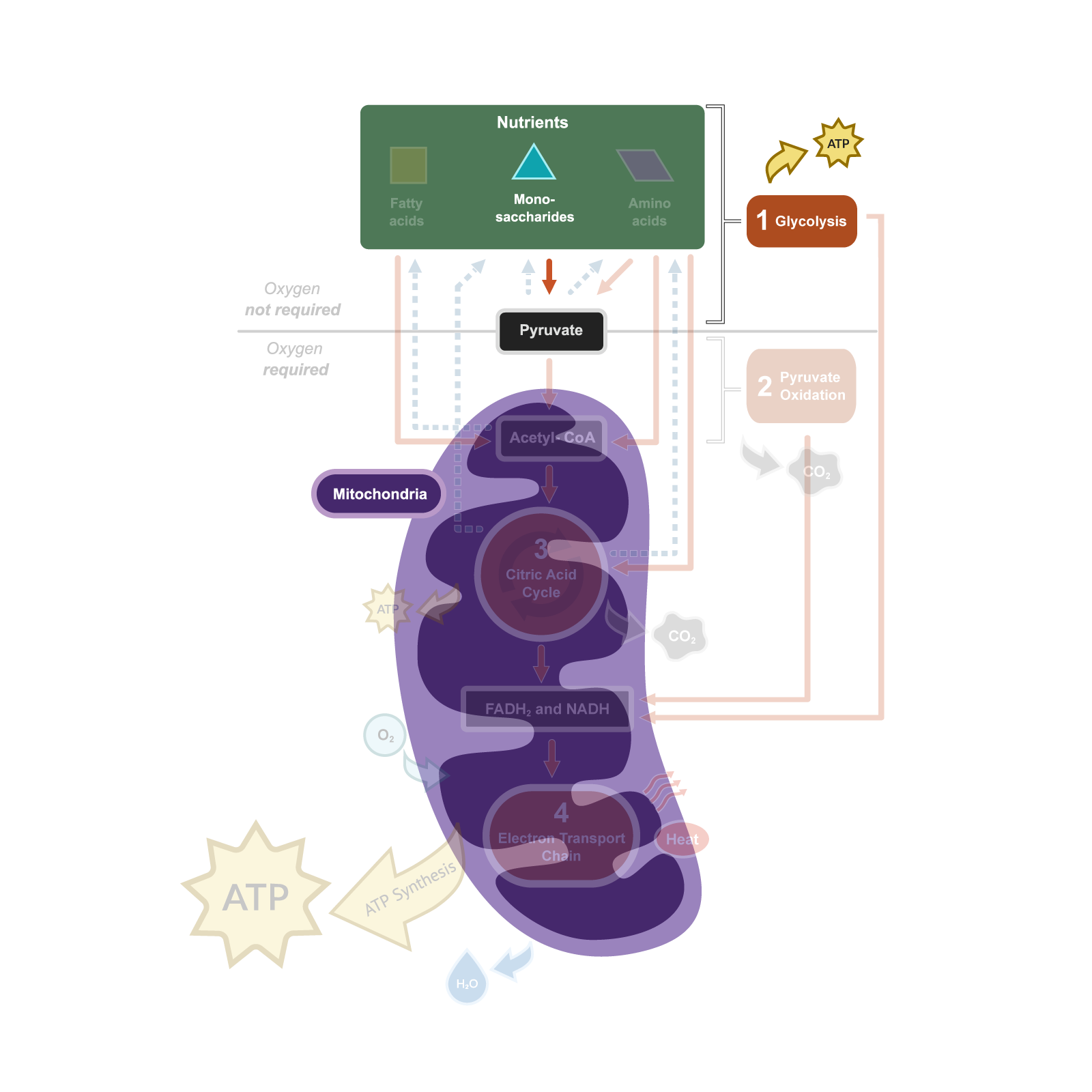
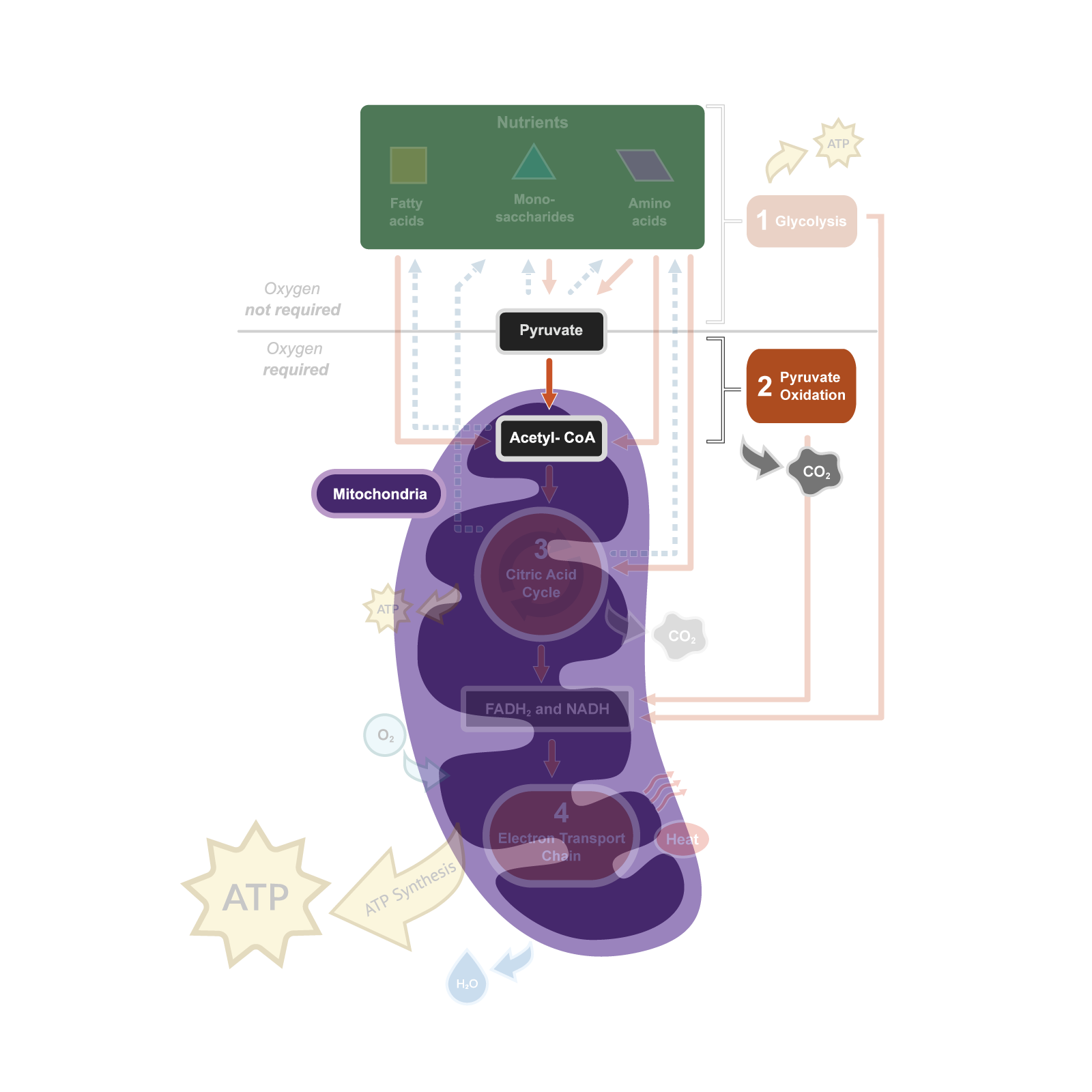
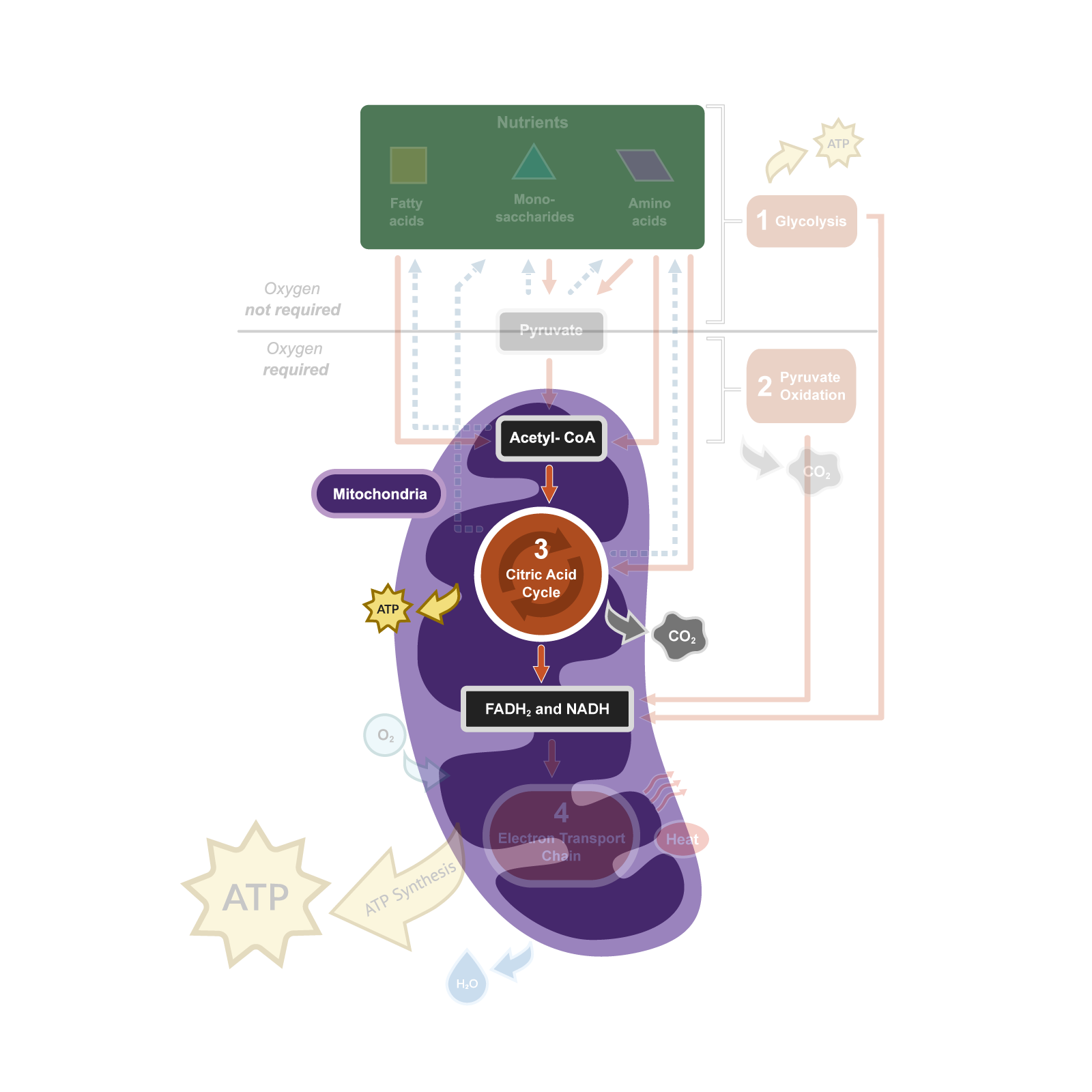
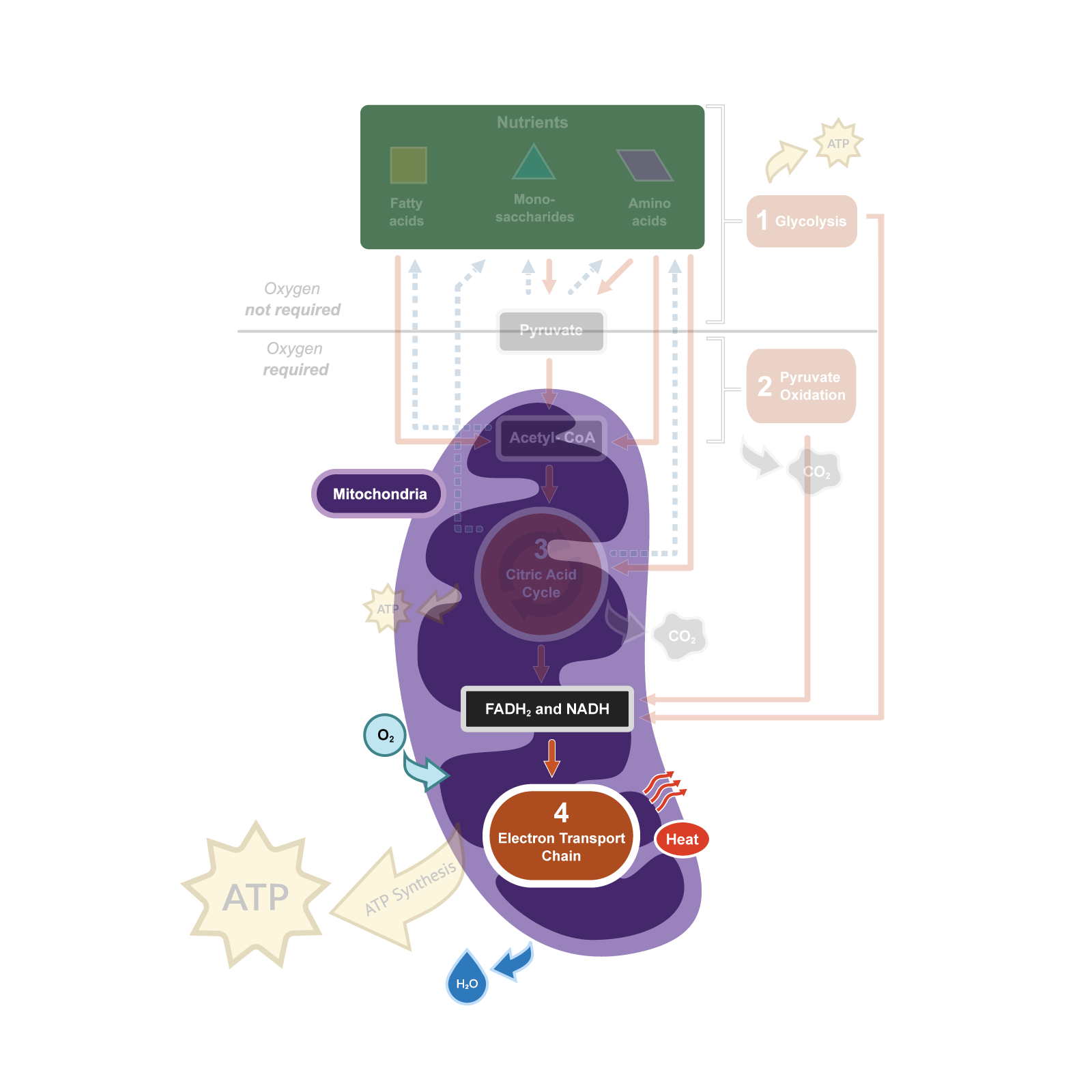
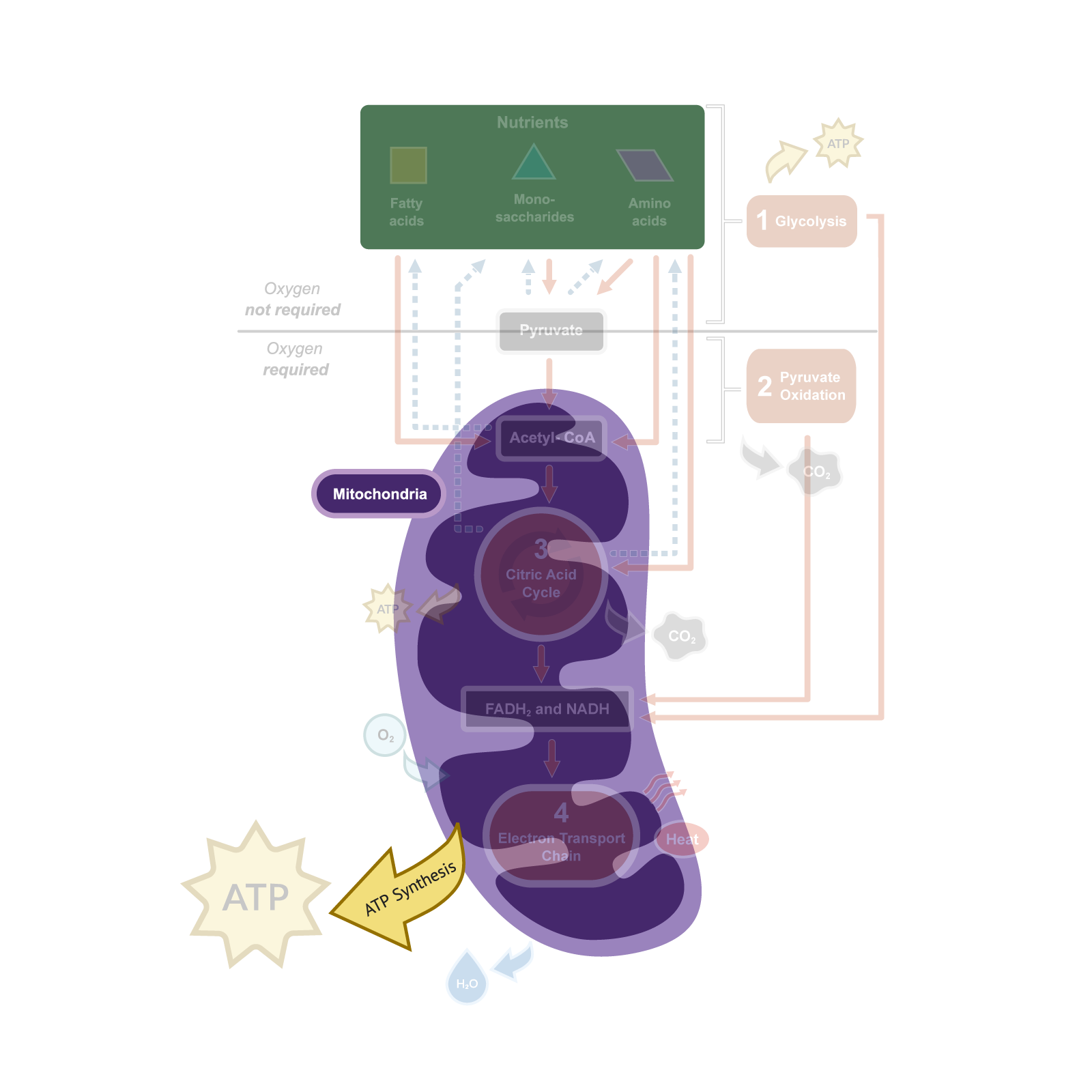
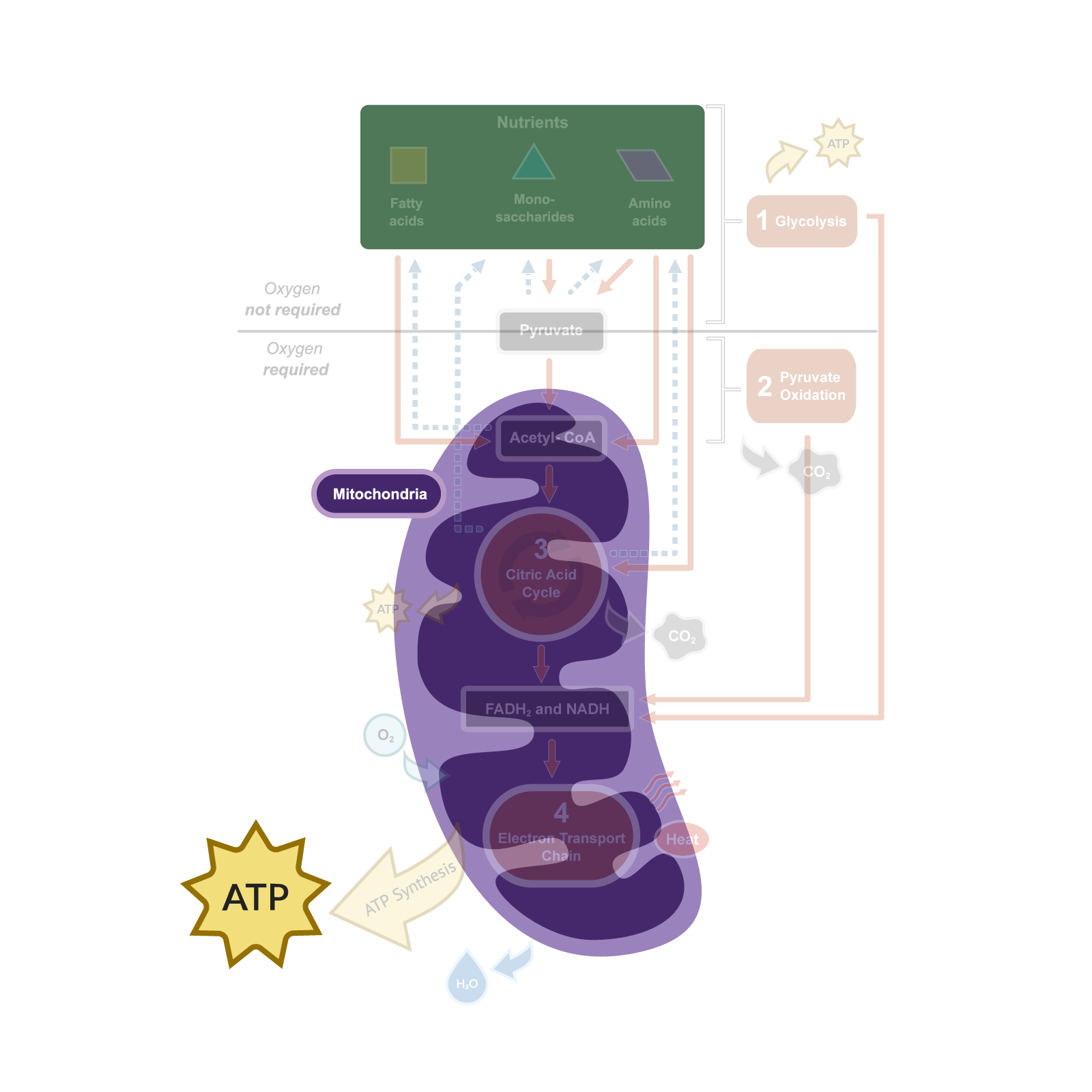
A schematic diagram depicting the process of cellular respiration in a series of steps.
At top is a rectangle labeled nutrients containing fatty acids, monosaccharides, and amino acids. A purple concave oval below nutrients is labeled Mitochondria. A dividing line under a rectangle labeled Pyruvate sits between the nutrients box and mitochondria. Above the dividing line, text: Oxygen not required. Below the line, text: Oxygen required.
A rounded box labeled 1 Glycolysis with a bracket contains the nutrients rectangle and Pyruvate. Red solid arrows point from Monosaccharides and Amino acids to Pyruvate and blue dotted arrows point in the opposite direction. A yellow arrow points from the Glycolysis box to a yellow star labeled A-T-P.
A rounded box labeled 2 Pyruvate oxidation with a bracket contains Pyruvate and a red solid arrow pointing to Acetyl-C-O-A within the top of the Mitochondria. Red solid arrows point from the fatty acids and Amino acids to Acetyl-C-O-A. A blue dotted arrow points from Acetyl-C-O-A back to fatty acids. A gray arrow points from the Pyruvate oxidation box to an irregular gray shape labeled C-O-2. Red solid arrows also lead from both the Glycolysis and Pyruvate oxidation boxes to a rectangle inside the mitochondria labeled F-A-D-H-2 and N-A-D-H.
A circle labeled 3 Citric Acid Cycle sits within the Mitochondria. Acetyl-C-O-A and a red solid arrow points down to Citric Acid Cycle. A red solid arrow points from Amino acids to Citric Acid Cycle. Blue dotted arrows lead from Citric Acid Cycle back to the Amino acids and the monosaccharides. A yellow arrow to the left of Citric Acid Cycle points to a yellow starburst shape labeled A-T-P... A gray arrow to the right of Citric Acid Cycle points to an irregular gray blob labeled C-O-2. A red solid arrow below Citric Acid Cycle points to F-A-D-H-2 and N-A-D-H also within the Mitochondria.
A rectangle labeled 4 Electron Transport Chain sits within the bottom of the Mitochondria. A red solid arrow below F-A-D-H-2 and N-A-D-H points down to Electron Transport Chain. A light blue circle labeled O-2 with an arrow sits outside and points into the Mitochondria. A blue droplet labeled H-2-O with an arrow sits outside and points away from the Mitochondria. To the right of the electron transport chain are three wavy red arrows labeled Heat. A large yellow arrow labeled ATP Synthesis points from the Mitochondria to a large yellow starburst labeled A-T-P outside the Mitochondria.
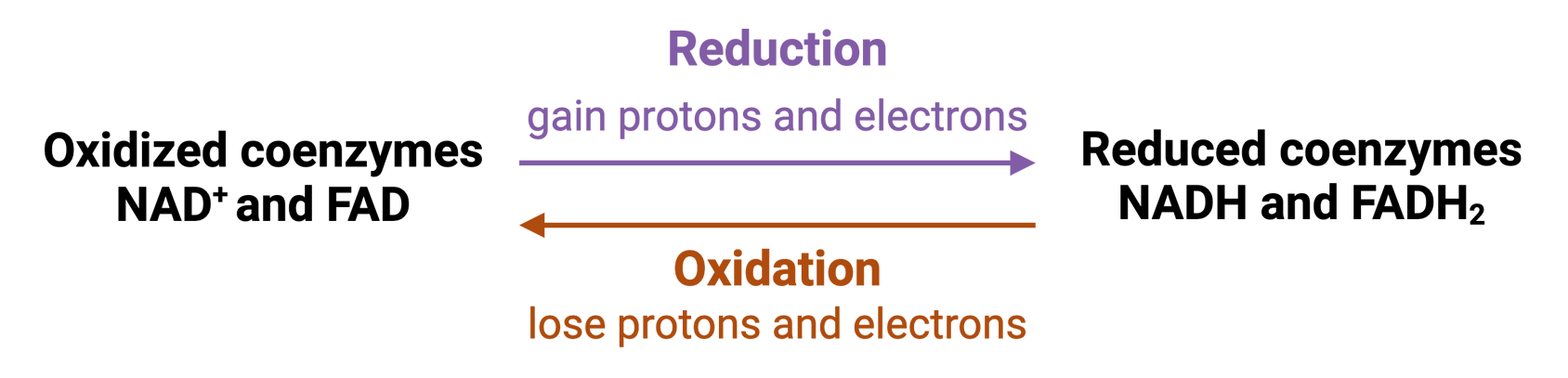
One electron carrier in cellular respiration is called NAD+ in its oxidized form (when it is not loaded with electrons) and NADH in its reduced form (when it is loaded with electrons). The other electron carrier is called FAD in its oxidized form and FADH2 in its reduced form. These electron carriers are also called “coenzymes,” meaning that they are molecules that help enzymes.
One electron carrier in cellular respiration is called NAD+ in its oxidized form (when it is not loaded with electrons) and NADH in its reduced form (when it is loaded with electrons). The other electron carrier is called FAD in its oxidized form and FADH2 in its reduced form. These electron carriers are also called “coenzymes,” meaning that they are molecules that help enzymes.
One electron carrier in cellular respiration is called NAD+ in its oxidized form (when it is not loaded with electrons) and NADH in its reduced form (when it is loaded with electrons). The other electron carrier is called FAD in its oxidized form and FADH2 in its reduced form. These electron carriers are also called “coenzymes,” meaning that they are molecules that help enzymes.
One electron carrier in cellular respiration is called NAD+ in its oxidized form (when it is not loaded with electrons) and NADH in its reduced form (when it is loaded with electrons). The other electron carrier is called FAD in its oxidized form and FADH2 in its reduced form. These electron carriers are also called “coenzymes,” meaning that they are molecules that help enzymes.